This is a fixed demonstration, not your personal result. The answer connections and exercises use the displayed sample answers. Literary character passages are shared editorial content.
One question to explore is how “Stay with the group” works alongside “Plan the response”. Start with the answer pairs below, then use the character as a second lens.
YOUR PERSONAL READING
How your choices work together.
Your belonging meets your response
Your pattern combines “Stay with the group” with “Plan the response”. These two preferences recur across the situations you answered. They describe a starting approach, not a skill or a guarantee of what you will do.
Question 1: A group you love has a rule that no longer feels fair.
Work within it to protect our unity.
Question 2: At an inn, someone is being unfairly blamed for a mistake.
Gather support before responding.
Where this could matter: Your group makes a choice you disagree with, and someone wants you to act now. Your first preference can guide what you protect; the second can guide how you handle the situation. Try writing one action that respects both, and name the cost you would accept. If both cannot fit, decide which matters more in this particular setting.
Compare all choices behind this connectionQuestion 1: A group you love has a rule that no longer feels fair.
Work within it to protect our unity.
Question 5: A friend asks you to support a choice you believe is wrong.
Stand beside them and address it later.
Question 9: Your companions choose a future you do not want.
Try to make their plan work for me.
Question 2: At an inn, someone is being unfairly blamed for a mistake.
Gather support before responding.
Question 6: The group’s supplies are missing just before departure.
Divide the search into planned tasks.
Question 10: You suspect tomorrow’s gathering will go badly.
Prepare a careful alternative.
This is a reflection prompted by your choices, not a finding about your motives.
Your closeness meets your protest
Your pattern combines “Trust your companions” with “Speak openly”. These two preferences recur across the situations you answered. They describe a starting approach, not a skill or a guarantee of what you will do.
Question 3: A traveler asks to join your table.
Share a meal and hear their story.
Question 4: A merchant changes the agreed price after you arrive.
Challenge the practice where others can hear.
Where this could matter: A companion asks for trust while you need to raise a difficult concern. Your first preference can guide what you protect; the second can guide how you handle the situation. Try writing one action that respects both, and name the cost you would accept. If both cannot fit, decide which matters more in this particular setting.
Compare all choices behind this connectionQuestion 3: A traveler asks to join your table.
Share a meal and hear their story.
Question 7: A companion admits something embarrassing about their past.
Share something honest in return.
Question 11: Friends suggest pooling money for the journey.
Create a common fund with clear records.
Question 4: A merchant changes the agreed price after you arrive.
Challenge the practice where others can hear.
Question 8: You notice one person always gets the hardest task.
Ask for a fair rotation before work continues.
Question 12: A person in charge dismisses a reasonable complaint.
Insist on a public response to the complaint.
This is a reflection prompted by your choices, not a finding about your motives.
A pattern to test in a different setting
Question 1: A group you love has a rule that no longer feels fair.
Work within it to protect our unity.
Question 9: Your companions choose a future you do not want.
Try to make their plan work for me.
Your choices here stay within a narrower part of your belonging. This is a pattern in these questions, not proof that you always act this way. Ask whether a different relationship or lower stakes would change your answer.
Two experiments built from your answers.
1. A small alternative to question 1
Question 1: A group you love has a rule that no longer feels fair.
Work within it to protect our unity.
Try: In a safe, low-stakes version of this situation, consider “Ask the group to revise it together.” instead. Do not use this exercise to override safety, consent or an important obligation.
Record: What did you expect? What happened? Did the alternative help, cost you something, or simply feel wrong for this setting? Keep your original approach if it serves the situation better.
2. A small alternative to question 2
Question 2: At an inn, someone is being unfairly blamed for a mistake.
Gather support before responding.
Try: In a safe, low-stakes version of this situation, consider “Interrupt and ask for a fair hearing.” instead. Do not use this exercise to override safety, consent or an important obligation.
Record: What did you expect? What happened? Did the alternative help, cost you something, or simply feel wrong for this setting? Keep your original approach if it serves the situation better.
Personal sections are assembled from your actual choices. The literary portrait and its source notes are shared with others who meet this character.
01 / A LITERARY LENS
A portrait to question, not inherit.
You notice how a shared purpose can bring people together. This reading separates the ability to organize belonging from the willingness to let companions disagree.
Where does your shared purpose leave room for another person to choose differently?
In the story
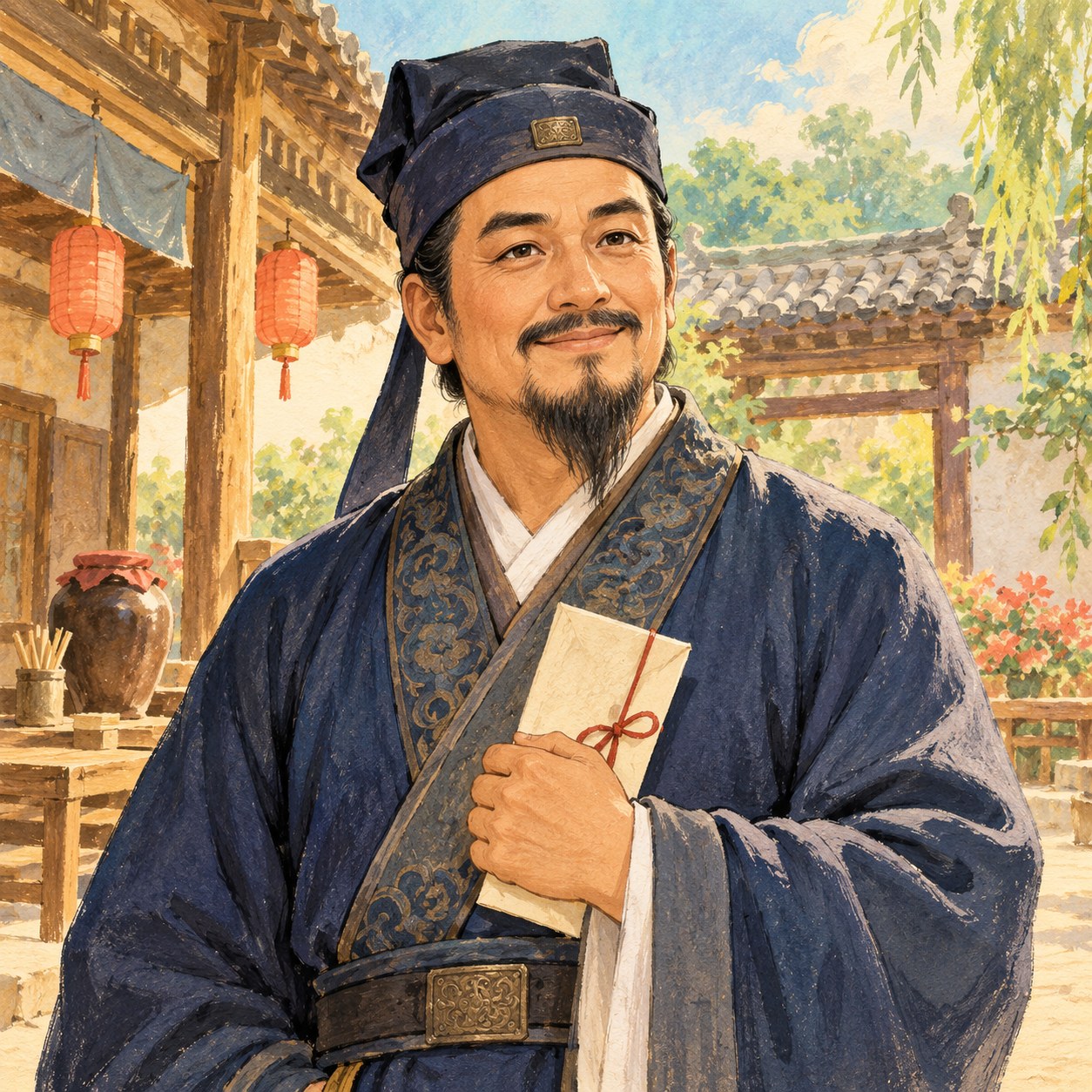
Song Jiang uses his position to warn a personal connection, putting a network obligation ahead of official procedure and taking practical steps to preserve that bond. His support for collective incorporation into state service complicates a simple rebel portrait, revealing a desire for recognized belonging and a visible shared purpose.
Where the analogy stops: Organizing a loyal network is different from trusting people to choose differently. In chapter 120 he poisons Li Kui to prevent a rebellion after his own death. The portrait must retain control alongside belonging.
This context concerns the fictional portrait. It does not assign the character’s motives, conduct or fate to you.
Where the two readings differ
Song Jiang and Wu Yong are most separated here:
Your protest: your response average is toward Speak openly. The Song Jiang portrait has a working placement toward Speak openly; Wu Yong is between Quiet resistance and Speak openly. These are editorial placements; a middle position may record limited evidence rather than an observed balanced trait. Compare the source notes before adopting either reading.
Your response: your response average is toward Plan the response. The Song Jiang portrait has a working placement between Plan the response and Intervene now; Wu Yong is toward Plan the response. These are editorial placements; a middle position may record limited evidence rather than an observed balanced trait. Compare the source notes before adopting either reading.
You do not inherit a character’s gender, fate, relationships or moral choices. No diagnosis, compatibility or supernatural claim is made.
02 / YOUR ANSWER TRAIL
Every reading has a trail.
Your belonging
Your average position leans toward Stay with the group.
See all 3 answers behind this reading
QUESTION 1 / THE GROUP RULE
A group you love has a rule that no longer feels fair.
Work within it to protect our unity.
QUESTION 5 / THE LOYALTY TEST
A friend asks you to support a choice you believe is wrong.
Stand beside them and address it later.
QUESTION 9 / THE DEPARTURE
Your companions choose a future you do not want.
Try to make their plan work for me.
Your response
Your average position leans toward Plan the response.
See all 3 answers behind this reading
QUESTION 2 / THE INN
At an inn, someone is being unfairly blamed for a mistake.
Gather support before responding.
QUESTION 6 / THE MISSING SUPPLIES
The group’s supplies are missing just before departure.
Divide the search into planned tasks.
QUESTION 10 / THE WARNING
You suspect tomorrow’s gathering will go badly.
Prepare a careful alternative.
Your closeness
Your average position leans toward Trust your companions.
See all 3 answers behind this reading
QUESTION 3 / THE STRANGER
A traveler asks to join your table.
Share a meal and hear their story.
QUESTION 7 / THE CONFESSION
A companion admits something embarrassing about their past.
Share something honest in return.
QUESTION 11 / THE SHARED PURSE
Friends suggest pooling money for the journey.
Create a common fund with clear records.
Your protest
Your average position leans toward Speak openly.
See all 3 answers behind this reading
QUESTION 4 / THE PRICE
A merchant changes the agreed price after you arrive.
Challenge the practice where others can hear.
QUESTION 8 / THE UNEQUAL WORK
You notice one person always gets the hardest task.
Ask for a fair rotation before work continues.
QUESTION 12 / THE LAST WORD
A person in charge dismisses a reasonable complaint.
Insist on a public response to the complaint.
Every answer has equal weight within its dimension; all four dimensions have equal weight in matching. The source notes support an editorial portrait, not a validated psychological score. Mixed answers describe different situations and are not treated as dishonesty.
03 / STRENGTHS TO EXPLORE
What your choices make room for.
From your actual responses
In “THE GROUP RULE” you chose “Work within it to protect our unity.”. Across the 3 questions about your belonging, your pattern leaves room for Stay with the group. Consider where that preference helps you make a useful contribution; the choices support a preference, not a measured skill.
Through the character lens
You can give separate contributions a recognizable shared purpose. That becomes more useful when participation can be questioned and freely declined.
How it helps in practice
A shared purpose can help separate contributions become visible as a collective effort. Explain the goal and the different reasons people might participate. A coalition becomes more dependable when its members understand their roles without having to share every conviction of its organizer.
The contribution people may notice
People may welcome an invitation that recognizes what they can contribute. Ask what they hope to gain as well as what the group needs from them. Belonging can include negotiated terms, changing roles and a respected way to leave the undertaking.
The character passages are shared literary prompts. They are not independently established findings about you.
04 / POSSIBLE BLIND SPOTS
Where context could change the picture.
From your actual responses
In “THE PRICE” you chose “Challenge the practice where others can hear.”. Try one low-stakes situation where the other end of your protest would be useful. A blind spot is a possibility to examine, not something these few answers establish.
Through the character lens
An appeal to loyalty can conceal control. Check whether someone can refuse your plan without losing your respect or their place in the group.
When the pattern goes too far
Loyalty becomes controlling when disagreement threatens someone’s standing rather than opening a discussion of the plan. Notice whether others can refuse a request without needing to prove affection or gratitude. Their ability to decline is evidence about the arrangement, not about disloyalty.
A small adjustment to try
An organizer may start deciding what others should sacrifice in order to preserve a shared reputation. Before accepting that tradeoff, ask whose interests are being protected and who consented to the cost. The survival of a group’s story is not everyone’s obligation.
05 / WITH OTHER PEOPLE
Let the differences start a conversation.
Compare the actual choices each person made, rather than assigning them a character’s behavior. An appeal to loyalty can conceal control. Check whether someone can refuse your plan without losing your respect or their place in the group. A literary resemblance cannot decide who is trustworthy or compatible.
Ask someone which of your actual answers surprised them, and why. A character label cannot tell you whom to trust, date, hire or avoid.
06 / SMALL EXPERIMENTS
Try something your answers can test.
Return to one situation in your answer trail. Keep your original choice, then describe one circumstance that would make another option useful. Try that alternative only in a low-stakes setting and notice what changes.
Where does your shared purpose leave room for another person to choose differently?
Name one situation this week where this pattern helped, and one where it cost you something.
Ask a trusted person for an example that challenges this portrait. Keep the parts that help.
Where does your shared purpose leave room for another person to choose differently?
07 / SOURCE NOTES
Why this character is drawn this way.
Declared reading: Water Margin, 120-chapter text tradition. Scenes and endings are kept within that declared version.
Organizing a loyal network is different from trusting people to choose differently. In chapter 120 he poisons Li Kui to prevent a rebellion after his own death. The portrait must retain control alongside belonging.
Chapter 18: warning Chao Gai of the investigation
Song Jiang uses his position to warn a personal connection, putting a network obligation ahead of official procedure and taking practical steps to preserve that bond.
His support for collective incorporation into state service complicates a simple rebel portrait, revealing a desire for recognized belonging and a visible shared purpose.
The coordinates are editorial interpretations of these scenes. Different scholars, translations or stages of a character’s story can support another reading. Evidence notes are not psychometric validation.
Source review · edition 4
Organizing a loyal network is different from trusting people to choose differently. In chapter 120 he poisons Li Kui to prevent a rebellion after his own death. The portrait must retain control alongside belonging.
Placement decisions and limits
Scale 3: Coalition control is not reciprocal trust. The midpoint is a provisional working placement under contradictory evidence, not an observed neutral temperament.
The four coordinates are working editorial placements, not values measured from a text. A provisional middle placement records uncertainty; it does not prove a neutral temperament. Evidence annotations are not probabilities and do not change the four equal matching weights.
Water Margin, 120-chapter text tradition. Scenes and endings are kept within that declared version.
This is a contemporary interpretation of Song Jiang in the source story, rather than a complete account of the character. Your result describes how your choices resemble this reading; it does not assign the character’s actions or morality to you.
Questions, profiles, interpretations and illustrations were developed with AI assistance. No modern screen-adaptation visual assets are used. This prototype has not been validated as a psychological instrument.