This is a fixed demonstration, not your personal result. The answer connections and exercises use the displayed sample answers. Literary character passages are shared editorial content.
One question to explore is how “Protect a shared home” works alongside “Prepare & observe”. Start with the answer pairs below, then use the character as a second lens.
YOUR PERSONAL READING
How your choices work together.
Your destination meets your method
Your pattern combines “Protect a shared home” with “Prepare & observe”. These two preferences recur across the situations you answered. They describe a starting approach, not a skill or a guarantee of what you will do.
Question 1: You arrive somewhere unexpectedly inviting, but people elsewhere are counting on your return.
Keep the return date and enjoy a short stay.
Question 2: A damaged sail slows your group before an important crossing.
Agree on a repair plan and gather the right materials.
Where this could matter: A commitment to return conflicts with a new direction, and your information is incomplete. Your first preference can guide what you protect; the second can guide how you handle the situation. Try writing one action that respects both, and name the cost you would accept. If both cannot fit, decide which matters more in this particular setting.
Compare all choices behind this connectionQuestion 1: You arrive somewhere unexpectedly inviting, but people elsewhere are counting on your return.
Keep the return date and enjoy a short stay.
Question 5: A pleasant routine is keeping you from a commitment you once chose.
Protect the commitment and rearrange the routine.
Question 9: Returning to an old group would mean giving up a new interest that matters to you.
Return and find a small place for the interest later.
Question 2: A damaged sail slows your group before an important crossing.
Agree on a repair plan and gather the right materials.
Question 6: You need supplies, but the harbor ahead is unfamiliar.
Prepare questions and a backup option first.
Question 10: A task matters to your companions, but its instructions are incomplete.
Write a provisional plan before beginning.
This is a reflection prompted by your choices, not a finding about your motives.
Your welcome meets your voice
Your pattern combines “Offer an open welcome” with “Speak & lead openly”. These two preferences recur across the situations you answered. They describe a starting approach, not a skill or a guarantee of what you will do.
Question 3: A newcomer asks to join your group for the evening.
Invite them in and get to know them gradually.
Question 4: Your companions disagree about the next part of the journey.
Propose a course and invite a clear decision.
Where this could matter: Someone new joins the group while you have a concern you need others to hear. Your first preference can guide what you protect; the second can guide how you handle the situation. Try writing one action that respects both, and name the cost you would accept. If both cannot fit, decide which matters more in this particular setting.
Compare all choices behind this connectionQuestion 3: A newcomer asks to join your group for the evening.
Invite them in and get to know them gradually.
Question 7: At an organized workshop, another participant offers tips for a task you are learning. You would…
Try one tip, then check whether it works for me.
Question 11: A person who made an awkward first impression asks for another chance to connect.
Meet again and learn more about them.
Question 4: Your companions disagree about the next part of the journey.
Propose a course and invite a clear decision.
Question 8: You notice a problem in a plan that everyone else seems pleased with.
Ask the group to stop and address it before proceeding.
Question 12: Your work helped the group, but no one seems to know what you contributed.
Ask openly for clearer recognition and shared credit.
This is a reflection prompted by your choices, not a finding about your motives.
A pattern to test in a different setting
Question 1: You arrive somewhere unexpectedly inviting, but people elsewhere are counting on your return.
Keep the return date and enjoy a short stay.
Question 9: Returning to an old group would mean giving up a new interest that matters to you.
Return and find a small place for the interest later.
Your choices here stay within a narrower part of your destination. This is a pattern in these questions, not proof that you always act this way. Ask whether a different relationship or lower stakes would change your answer.
Two experiments built from your answers.
1. A small alternative to question 1
Question 1: You arrive somewhere unexpectedly inviting, but people elsewhere are counting on your return.
Keep the return date and enjoy a short stay.
Try: In a safe, low-stakes version of this situation, consider “Ask the people waiting whether the plan can change.” instead. Do not use this exercise to override safety, consent or an important obligation.
Record: What did you expect? What happened? Did the alternative help, cost you something, or simply feel wrong for this setting? Keep your original approach if it serves the situation better.
2. A small alternative to question 2
Question 2: A damaged sail slows your group before an important crossing.
Agree on a repair plan and gather the right materials.
Try: In a safe, low-stakes version of this situation, consider “Try a small repair and check how it holds.” instead. Do not use this exercise to override safety, consent or an important obligation.
Record: What did you expect? What happened? Did the alternative help, cost you something, or simply feel wrong for this setting? Keep your original approach if it serves the situation better.
Personal sections are assembled from your actual choices. The literary portrait and its source notes are shared with others who meet this character.
01 / A LITERARY LENS
A portrait to question, not inherit.
You can grow into a responsibility through a first conversation or departure. In this reading, finding your own voice serves a shared home rather than requiring you to leave it behind.
What could I learn if this next step did not have to prove anything?
In the story
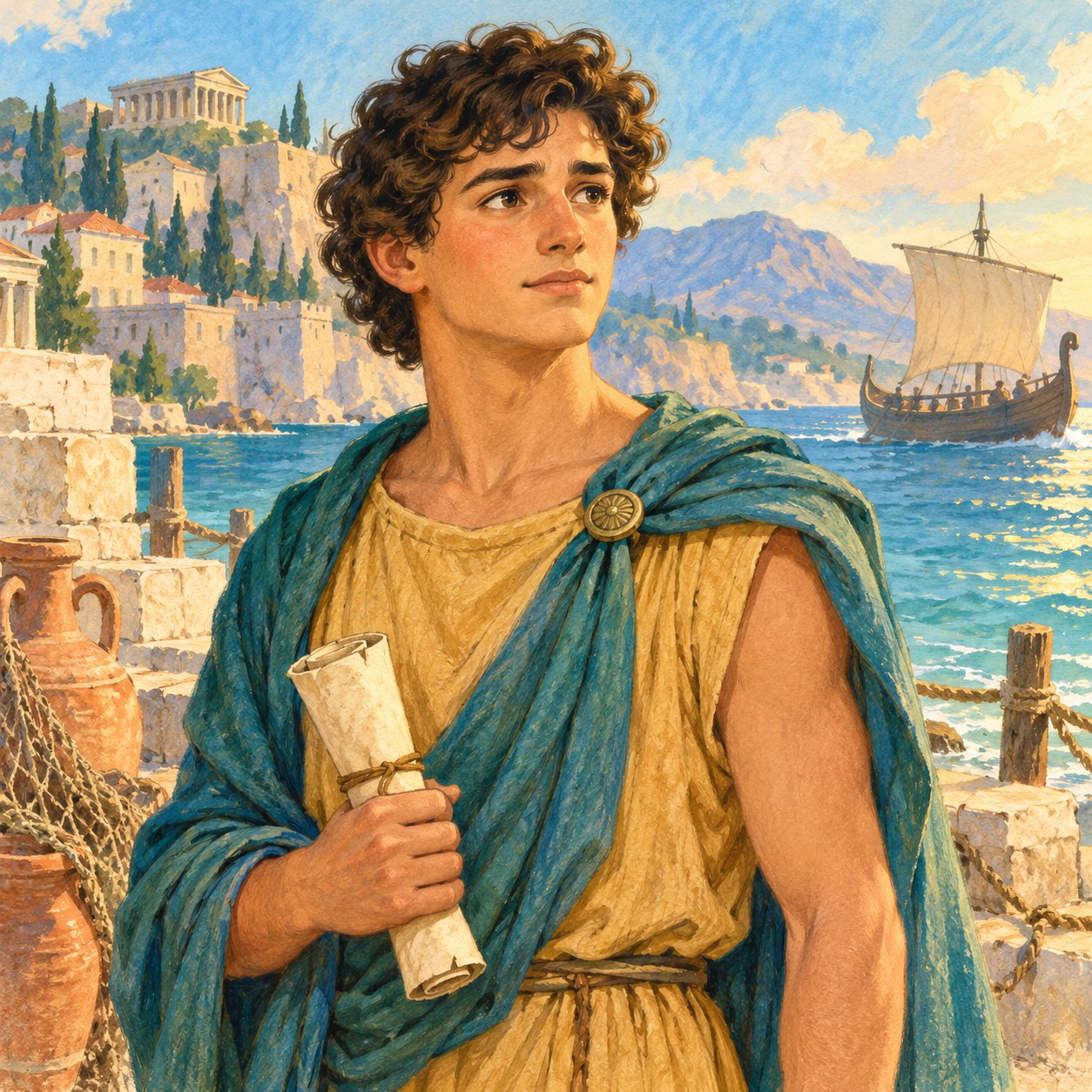
Telemachus takes a public step beyond a frustrated household position, combining a wish to protect home with the risks of a developing independent voice. His return requires accepting counsel and adjusting a route under threat, complicating the idea that growing agency means unrestricted openness or ceaseless improvisation.
Where the analogy stops: Leaving home to seek his father develops agency in service of household restoration. Growing independent is not the same as preferring a new destination over the shared home.
This context concerns the fictional portrait. It does not assign the character’s motives, conduct or fate to you.
Where the two readings differ
Telemachus and Athena are most separated here:
Your method: your response average is toward Prepare & observe. The Telemachus portrait has a working placement between Prepare & observe and Experiment & adapt; Athena is toward Prepare & observe. These are editorial placements; a middle position may record limited evidence rather than an observed balanced trait. Compare the source notes before adopting either reading.
Your voice: your response average is toward Speak & lead openly. The Telemachus portrait has a working placement toward Speak & lead openly; Athena is between Influence quietly and Speak & lead openly. These are editorial placements; a middle position may record limited evidence rather than an observed balanced trait. Compare the source notes before adopting either reading.
You do not inherit a character’s gender, fate, relationships or moral choices. No diagnosis, compatibility or supernatural claim is made.
02 / YOUR ANSWER TRAIL
Every reading has a trail.
Your destination
Your average position leans toward Protect a shared home.
See all 3 answers behind this reading
QUESTION 1 / THE NEW SHORE
You arrive somewhere unexpectedly inviting, but people elsewhere are counting on your return.
Keep the return date and enjoy a short stay.
QUESTION 5 / THE COMFORTABLE DELAY
A pleasant routine is keeping you from a commitment you once chose.
Protect the commitment and rearrange the routine.
QUESTION 9 / THE DIFFERENT HOMECOMING
Returning to an old group would mean giving up a new interest that matters to you.
Return and find a small place for the interest later.
Your method
Your average position leans toward Prepare & observe. This dimension differs from the Telemachus portrait. Treat that part of the character description as a question, not a finding about you.
See all 3 answers behind this reading
QUESTION 2 / THE DAMAGED SAIL
A damaged sail slows your group before an important crossing.
Agree on a repair plan and gather the right materials.
QUESTION 6 / THE UNKNOWN HARBOR
You need supplies, but the harbor ahead is unfamiliar.
Prepare questions and a backup option first.
QUESTION 10 / THE MISSING INSTRUCTIONS
A task matters to your companions, but its instructions are incomplete.
Write a provisional plan before beginning.
Your welcome
Your average position leans toward Offer an open welcome.
See all 3 answers behind this reading
QUESTION 3 / THE STRANGER AT THE TABLE
A newcomer asks to join your group for the evening.
Invite them in and get to know them gradually.
QUESTION 7 / THE OFFER OF HELP
At an organized workshop, another participant offers tips for a task you are learning. You would…
Try one tip, then check whether it works for me.
QUESTION 11 / THE SECOND INTRODUCTION
A person who made an awkward first impression asks for another chance to connect.
Meet again and learn more about them.
Your voice
Your average position leans toward Speak & lead openly.
See all 3 answers behind this reading
QUESTION 4 / THE UNCLEAR COURSE
Your companions disagree about the next part of the journey.
Propose a course and invite a clear decision.
QUESTION 8 / THE HIDDEN DOUBT
You notice a problem in a plan that everyone else seems pleased with.
Ask the group to stop and address it before proceeding.
QUESTION 12 / THE RECOGNITION
Your work helped the group, but no one seems to know what you contributed.
Ask openly for clearer recognition and shared credit.
Every answer has equal weight within its dimension; all four dimensions have equal weight in matching. The source notes support an editorial portrait, not a validated psychological score. Mixed answers describe different situations and are not treated as dishonesty.
03 / STRENGTHS TO EXPLORE
What your choices make room for.
From your actual responses
In “THE NEW SHORE” you chose “Keep the return date and enjoy a short stay.”. Across the 3 questions about your destination, your pattern leaves room for Protect a shared home. Consider where that preference helps you make a useful contribution; the choices support a preference, not a measured skill.
Through the character lens
You learn through participation and invite support without treating uncertainty as a reason to remain still.
How it helps in practice
You can let participation teach you something that preparation alone cannot settle. Asking a question, taking a modest responsibility, or making a first introduction may help your own judgment become clearer through contact with the actual situation.
The contribution people may notice
Your openness to guidance can make a new stage less lonely without requiring you to surrender its direction. Comparing another person’s experience with your own observation may give you a richer basis for choosing than either imitation or total self-reliance.
The character passages are shared literary prompts. They are not independently established findings about you.
04 / POSSIBLE BLIND SPOTS
Where context could change the picture.
From your actual responses
In “THE DAMAGED SAIL” you chose “Agree on a repair plan and gather the right materials.”. Try one low-stakes situation where the other end of your method would be useful. A blind spot is a possibility to examine, not something these few answers establish.
Through the character lens
Wanting to prove readiness can make every decision feel like a public test. Separate the useful learning step from the need to look certain.
When the pattern goes too far
A wish to look ready can turn an ordinary attempt into a public examination. Decide what you are trying to learn before beginning, so an imperfect outcome can provide useful evidence instead of seeming to settle the question of whether you belong.
A small adjustment to try
Finding your voice can sometimes become an effort to sound unlike the people who previously spoke for you. Take a moment to identify what you actually think, allowing a position to be yours even when it partly agrees with someone established.
05 / WITH OTHER PEOPLE
Let the differences start a conversation.
Compare the actual choices each person made, rather than assigning them a character’s behavior. Wanting to prove readiness can make every decision feel like a public test. Separate the useful learning step from the need to look certain. A literary resemblance cannot decide who is trustworthy or compatible.
Ask someone which of your actual answers surprised them, and why. A character label cannot tell you whom to trust, date, hire or avoid.
06 / SMALL EXPERIMENTS
Try something your answers can test.
Return to one situation in your answer trail. Keep your original choice, then describe one circumstance that would make another option useful. Try that alternative only in a low-stakes setting and notice what changes.
Make one small decision without rehearsing how impressive it will look.
Ask someone experienced about a mistake they learned from.
Record what a first attempt taught you before judging its outcome.
What could I learn if this next step did not have to prove anything?
07 / SOURCE NOTES
Why this character is drawn this way.
Declared reading: Homer, Odyssey. Episode locations are checked with the Greek text and Butler’s public-domain English rendering. Translation is a reading aid, not numerical personality evidence.
Leaving home to seek his father develops agency in service of household restoration. Growing independent is not the same as preferring a new destination over the shared home.
Odyssey, Book 2: addressing the assembly and preparing to depart
Telemachus takes a public step beyond a frustrated household position, combining a wish to protect home with the risks of a developing independent voice.
Odyssey, Book 15: the return journey and its precautions
His return requires accepting counsel and adjusting a route under threat, complicating the idea that growing agency means unrestricted openness or ceaseless improvisation.
The coordinates are editorial interpretations of these scenes. Different scholars, translations or stages of a character’s story can support another reading. Evidence notes are not psychometric validation.
Source review · edition 4
Leaving home to seek his father develops agency in service of household restoration. Growing independent is not the same as preferring a new destination over the shared home.
Placement decisions and limits
Scale 1: The journey seeks his father and restoration of the household; growing agency does not imply a preference for a new horizon.
The four coordinates are working editorial placements, not values measured from a text. A provisional middle placement records uncertainty; it does not prove a neutral temperament. Evidence annotations are not probabilities and do not change the four equal matching weights.
Homer, Odyssey. Episode locations are checked with the Greek text and Butler’s public-domain English rendering. Translation is a reading aid, not numerical personality evidence.
Telemachus’s search for news and his growing participation in the household’s affairs inspire this portrait. It is about emerging agency, not a fixed account of adulthood or an expectation to imitate his actions.
Questions, profiles, interpretations and illustrations were developed with AI assistance. No modern screen-adaptation visual assets are used. This prototype has not been validated as a psychological instrument.